

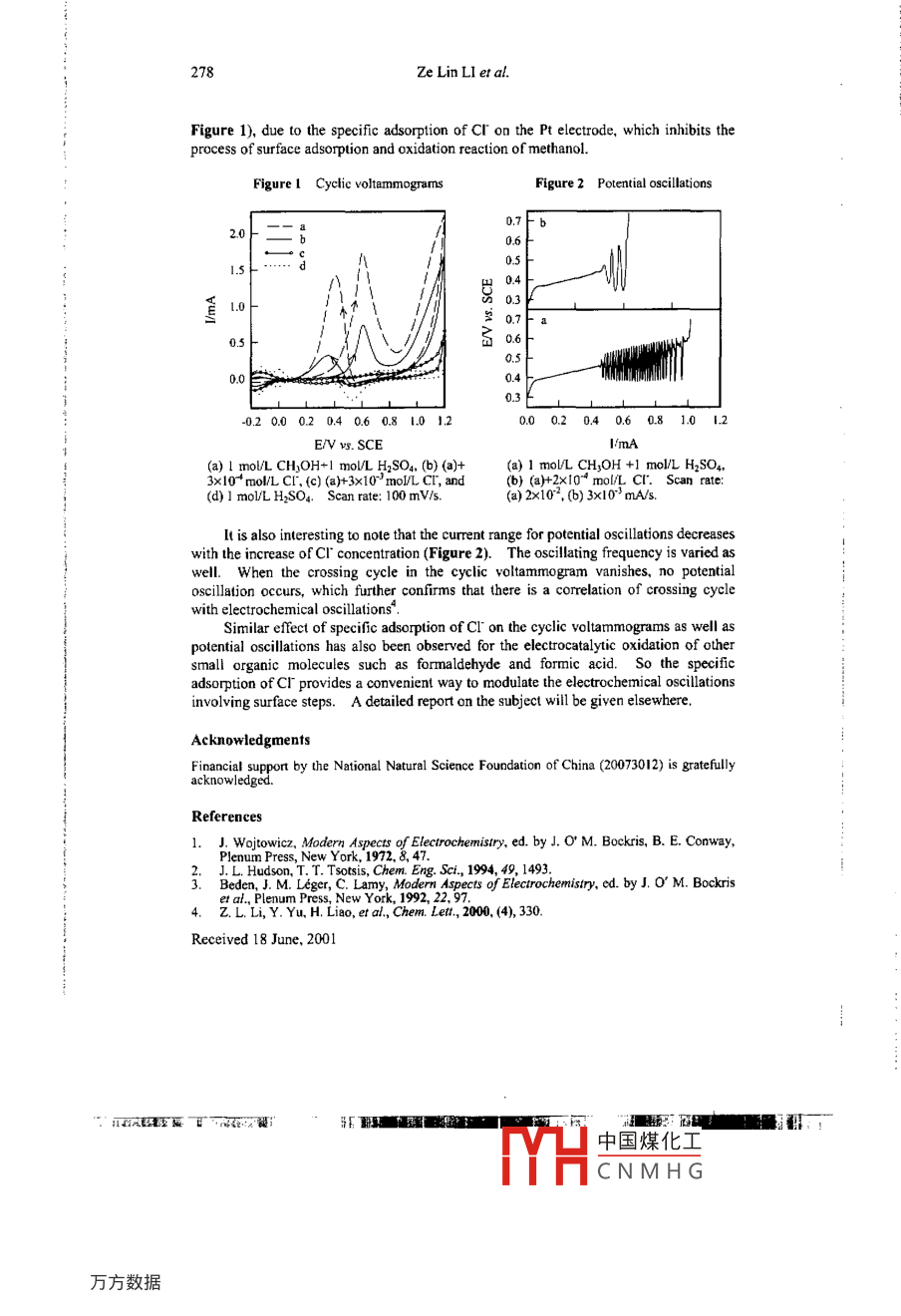
Chinese Chemical Letters Vol. 13, No. 3, pp 277 - 278, 2002277htp://www.imm.ac .cn/jounalccl.htmlModulation of Electrochemical Oscillations by Specific Adsorption ofCIr during the Electrooxidation of Methanol on Pt Eleetrode06AZe Lin LI *, Ji Hua HUANG, Xiao Ming XIAO, Yue ZENG, Xia CHUDeparlment of Chemistry, Hunan Normal University, Changsha 410081Abstract: Potential oscillation during the electrocatalytic oxidation of methanol can be modulatedby the specifc adsorption of CT on the platinum electrode, which suppresses the electrocatalyticoxidation of metbanol, and makes the cross cycle in the cyelic voltamumogram become smaller andfinally disappear with the increase of CI concentation. The method is also applicable to theelectrocatalytic oxidation of other small organic molecules.Keywords: Methanol, chloride ions, specific adsorption, potential ocilation, modulation.Ocillations during the electrocatalytic oxidation of smallan active area of research for more than half a century"?. Different enhancement orinhibiting eflects are found by surface modification of platinum electrode using adatoms'underpotentially deposited (e.g., Pb, Sn) or ireversibly adsorbed (e.g, Bi, S). Althoughcyclic voltammetry is a routine method employed in the study of catalytic activity ofelectrodes, few researchers have devoted to establish the relationship of cyclicvoltammogram with electrochemical oscillations.In this ltter, the effect of specific adsorption of Cr on the voltammetric behaviorfor the electrooxidation of methanol and its connection with the potential oscilation hasbeen studied.Figure 1 shows the cyclic voltammograms for methanol oxidation on a platinumwire electrode (1 mm in diameter, and 8 mm in length) with different Cr concentrationsin the base solution of 1 mol/L H2SO4. When there is no CI (curve ), oxidation peaksappear at about 0.6 and 0.4 V during the forward and backward potential scan,respectively, from which a crossing cycle occurs, ie, the oxidation curent for thebackward scan is larger than that for the forward scan in a range of potentials.Poisoning CO that forms at lower potentials can be removed at higher potentialsthrough reaction with OHsd, and the larger reverse scan current results from the oxidatiorof methanol on a reactivated electrode surface. The electrode surface becomespoisoned again while the potential returms ioto the H adsorption range. The formationand removal of CO。consist of a pair of positive and negative feedback steps. Thecrossing cycle that represents the two feedback steps is a typical topology forelectrochemical oscillatory systems. With the increase of Cr concentration, thecrossing cycle becomes smaller (curve b of Figure 1), and finally disappears (curvec of●E-mail: wujina@sparc2 .hunnu.cdc.cn中國(guó)煤化工一TYHCNMHG278Ze LinLI et al.Figure 1), due to the specific adsorption of Cr on the Pt electrode, which inhibits theprocess of surface adsorption and oxidation reaction of methanol.Figure 1 Cyclic voltammogramsFigure 2 Potential oscillations0.7Ft0.60.1.5y 0.4W另0.3直1.0多0.7F0.5旨0.6|0.3-0.2 0.0 0.2 0.4 0.6 0.8 I.0 1.20.0 0.2 0.4 0.6 0.8 1.0 1.2E/V vy. SCEI/mA(a) 1 mol/L CH,OH+1 mol/L H2SO4, (b) (a)+(a) 1 mol/L CH,OH +1 mol/L HSO4,3x10+ mol/L cr, (c) (a)+3x10) mol/L Cr, and(b) (a)+2x10⁴ mol/L Cr. Scan rat:(d) i mol/L H2SO4Scan rate: 100 mV/s.(a) 2x10*, (b) 3x10⁻³ mA/s.It is also interesting to note that the curent range for potential oscillations decreaseswith the increase of CIr concentration (Figure 2). The oscillating frequency is varied aswell. When the crossing cycle in the cyclic voltammogram vanishes, no potentialoscillation occurs, which further confirms that there is a correlation of crossing cyclewith electrochemical oscillations' .Similar efect of specific adsorption of CI on the cyclic voltammograms as well aspotential oscillations has also been observed for the electrocatalytic oxidation of othersmall organic molecules such as formaldehyde and formic acid. So the specificadsorption of Cr provides a convenient way to modulate the electrochemical oscillationsinvolving surface steps. A detailed report on the subject will be given elsewhere.AcknowledgmentsFinancial suppont by the National Natural Science Foundation of China (20073012) is gratefullyacknowledged.References1. J. Wojtowicz. Modern Aspects of Electrochemistry, ed. byJ.0' M. Bockris, B. E. Conway,Plenum Press, New York, 1972, 8, 47.J L Hudson, T. T. Tsotsis, Chem. Eng. Sci, 1994, 49, 1493.Beden, J. M. Leger, C. Lamy, Modern Aspects of Electrochemistry, ed. byJ. 0' M. Bockrise! al. Plenum Press, New York, 1992,4. Z.L. Li, Y. Yu, H. Liao, et al, Chem. Lett,, 2000, (4), 330.Received 18 June, 2001中國(guó)煤化工TYHCNMHG


-
C4烯烴制丙烯催化劑 2020-07-08
-
煤基聚乙醇酸技術(shù)進(jìn)展 2020-07-08
-
生物質(zhì)能的應(yīng)用工程 2020-07-08
-
我國(guó)甲醇工業(yè)現(xiàn)狀 2020-07-08
-
石油化工設(shè)備腐蝕與防護(hù)參考書十本免費(fèi)下載,絕版珍藏 2020-07-08
-
四噴嘴水煤漿氣化爐工業(yè)應(yīng)用情況簡(jiǎn)介 2020-07-08
-
Lurgi和ICI低壓甲醇合成工藝比較 2020-07-08
-
甲醇制芳烴研究進(jìn)展 2020-07-08
-
精甲醇及MTO級(jí)甲醇精餾工藝技術(shù)進(jìn)展 2020-07-08