

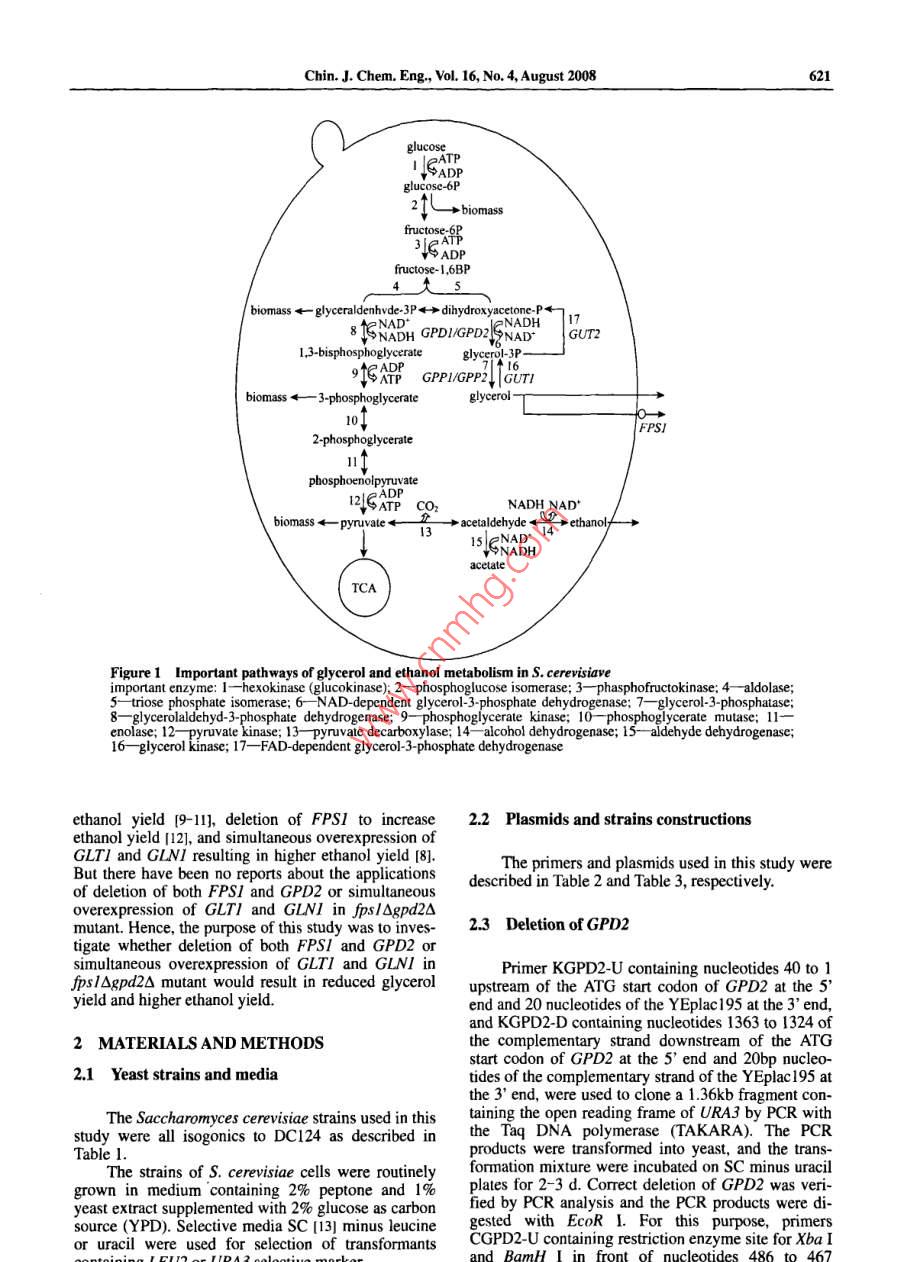
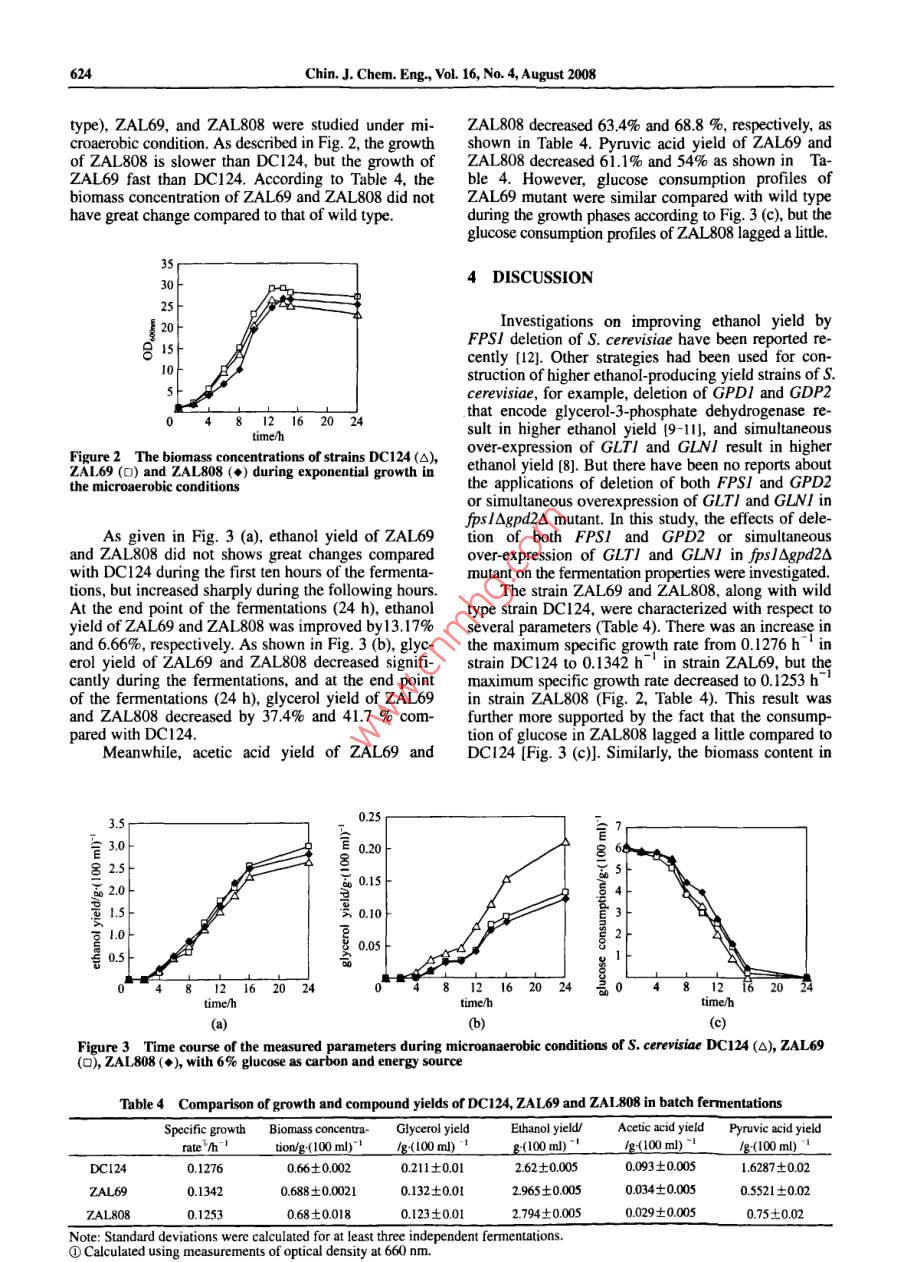
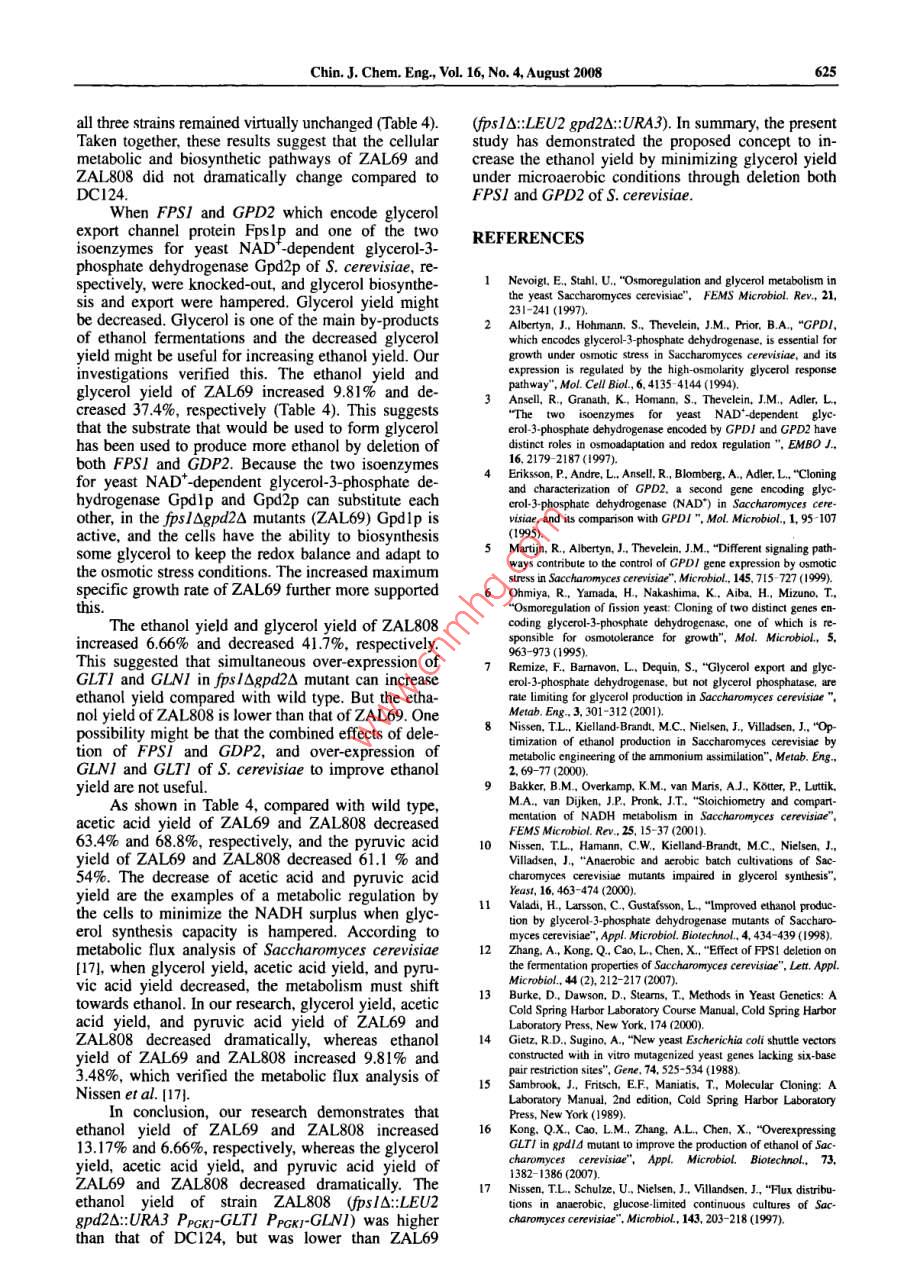
Chinese Joumal of Chemical Engineering, 16(4)620--625(2008Improve Ethanol Yield Through Minimizing Glycerol Yield inEthanol Fermentation of Saccharomyces cerevisiaeZHANG Aili(張愛(ài)利) and CHEN Xun(陳洵)*School of Chemical Engineering and Technology, Tianjin University, Tianjin 300072, ChinaAbstract In ethanol fermentation of Saccharomyces cerevisiae(S. cerevisiae), glycerol is one of the mainby-products. The purpose of this investigation was to increase ethanol yield through minimizing glycerol yieldng mutants in which FPS encoding a channel protein that mediates glycerol export andng onelycerol-3-phosphate dehydrogenase were knocked-out using one-step gene replacement. GLTI and GLN/ that en-code glutamate synthase and glutamine synthetase, respectively, wxpressed using two step gene replament in fps.△gpd2△ mutant. The fermentationles of ZAL69sl△:EU2gpd2△:U/RA3) and ZAL808(s△:LEU2gpd2△:URA3PeCKr-GLNI) under microaerobic conditions were investigated and comared with those of wild type(DC124). Consumption of glucose, yield of ethanol, yield of glycerol, acetic acid, andyruvic acid were monitored. Compared with wild type, the ethanosed by 37 4g and 41.7 %. Mean while, Provexpression of GLTI and GLNI in fps IAgpd2A mutant did not have a higher ethanol yield than fps / Agpd2A mutarKeywords Saccharomyces cerevisiae, ethanol yield, glycerol yield, gene knock-out, gene over-express, FPSIGPD2, GLNI GLTI1 INTRODUCTIONGPPI is stimulated under anaerobicGlycerol-3-phosphate dehydrogenase,In ethanol fermentation of Saccharomyces cere- erol phosphatase, is rate-limiting forvisiae(S. cerevisiae), in addition to biomass and cartion in S cerevisiae (7Ibon dioxide, a number of byproducts are produced,Ammonium is often used as nitrogen sourcesuch as glycerol and organic acids (e.g acetic acid industrial fermentations of S cerevisiae. Transportedand pyruvic acid, succinic acid ). Approximately 5% across the membrane into the cytoplasm, ammoniumcarbon source is converted into glycerol in ethanol Is assimilated into glutamate by reaction withfermentation. Eliminating formation of glycerol can a-oxoglutarate. This consists of two coupled reactionscerevisiaewithout increasing the overall cost of carbon sourceencoded by GLTl, and glutamine synthetase(GS)Fig. I presents important pathways of glycerol and (Reaction 2), encoded by GLNI. The expression andethanol metabolism in S. cerevisiaeregulation of glutamate synthase(GoGAT)have beenGlycerol formation has two roles in the fermentation of S. cerevisiae [I]. Under anaerobic fermenta-a-oxoglutarate+ glutamine NADH-tions when the respiratory chain is not functioning, netformation of NADH produced during synthesis ofglutamate + NADbiomass and organic acids, i.e., acetic acid, and pyruglutamate+NH4+ATP→→ guanine+ADP+Pivic acid, must be reoxidized to NAd by formation ofglycerol in order to avoid a serious imbalance in theNAD/NADH ratio. Synthesis of I mol glycerol froma-oxoglutarate+ NH4+ NADH+ ATPglucose leads to reoxidation of I mol NADH. Fur-thermore, during growth under osmotic stress condi-glutamate NAD+ ADP + Pitions, glycerol is formed and accumulated insideBy over-expressing both GLTI and GLNI it shouldcell where it works as an efficient osmolyte thatbe possible to convert NADH to NAD in the synthetects the cell against lysis.sis of glutamate from ammonium and 2-oxoglutarateThe yield of glycerol is controlled by its biosyn- resulting in a reduced surplus formation of NAdh andthetic pathway as well as by regulated transmembrane thus, a lower glycerol production. The geneticalltransport systems. Glycerol is produced from the glynodified strain probably will have an additional re-colytic intermediate dihydroxyacetone phosphate in quirement for synthesis of ATP because Reaction 2two steps catalyzed by NAD-dependent glycerol-3- requires ATP. Presumably the larger drain of ATP willphosphate dehydrogenase and glycerol-3-phosphate be compensated by a higher ethanol production(81phosphatase. Both enzymes are encoded by two simiStrategies had been used for construction oflar isogenes, GPDI plus GPD2 and GPPI plus GPP2, higher ethanol yield strains of S cerevisiae, for exam-respectively. Expression of GPDI and GPP2 isple, deletion of GPD/ and GPD2 which encodeduced by high osmolarity, whereas that of GPD2 and glycerol-3-phosphate dehydrogenase resulting higherReceived 2007-08-13, accepted 2008-03-26Supported by the National High Technology Research and Development Prof China(2002AA647040)Chin J. Chem Eng, Vol. 16, No 4, August 2008ISaTbiomass部Abiomass +glyceraldenhvde-3P +-dihydroxyacetone-P




-
C4烯烴制丙烯催化劑 2020-03-23
-
煤基聚乙醇酸技術(shù)進(jìn)展 2020-03-23
-
生物質(zhì)能的應(yīng)用工程 2020-03-23
-
我國(guó)甲醇工業(yè)現(xiàn)狀 2020-03-23
-
四噴嘴水煤漿氣化爐工業(yè)應(yīng)用情況簡(jiǎn)介 2020-03-23
-
Lurgi和ICI低壓甲醇合成工藝比較 2020-03-23
-
甲醇制芳烴研究進(jìn)展 2020-03-23
-
精甲醇及MTO級(jí)甲醇精餾工藝技術(shù)進(jìn)展 2020-03-23